The City of Pikeville is currently reviewing proposed updates to its zoning ordinance and zoning map. These updates are intended to comply with changes in Kentucky law, including KRS 100.348, and to modernize portions of the city’s zoning regulations.
The goal of these updates is to protect neighborhood character, support appropriate housing and business development, and ensure the city’s zoning framework reflects how Pikeville continues to grow.
This page provides information about the proposed changes, including an interactive map that allows residents to compare the current zoning map with the proposed zoning map, review supporting materials, and submit comments during the review process.
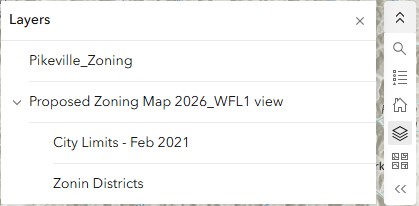
The interactive map allows residents to explore zoning districts across the City of Pikeville and compare the current zoning map with the proposed zoning map.
Viewing Current vs. Proposed Zoning
This allows you to toggle between the two maps to compare zoning in different areas of the city.
Zooming
Changing the Background
Click the Basemap button to change the background to aerial imagery, streets, or other map
styles.
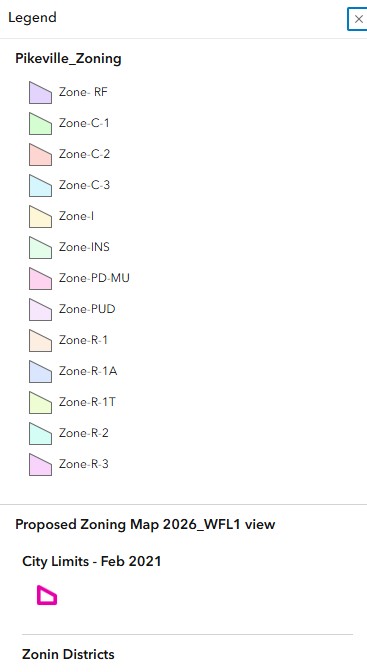
Legend
Click the Legend button to see the colors used for each zoning district on the map.
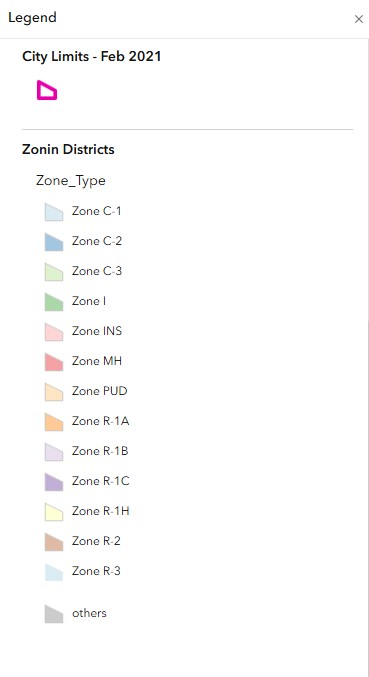
The following residential zoning districts are used in the city’s current zoning ordinance.
R-1 – One-Family Residential District
Primarily single-family homes on individual lots.
R-1A – Inner-City One-Family Residential District
Single-family homes in older, more compact neighborhoods closer to the city center.
R-1T – Townhouses Residential District
Townhouse-style residential development.
R-2 – One- and Two-Family Residential District
Allows single-family homes and duplexes.
R-3 – One- and Multiple-Family Residential District
Allows a mix of housing types, including multi-family residences.
MP – Mobile Home Park District
Areas designated for mobile home park developments.
The proposed zoning map reorganizes residential districts to better reflect existing neighborhood patterns and current housing needs.
R-1A – Traditional Single-Family Residential District
Single-family homes in established neighborhoods with traditional development patterns.
All single-family dwellings constructed in this zone shall meet the following minimum architectural compatibility standards:
(1) Minimum livable area: 900 sq ft
(2) Minimum roof pitch: 4:12
(3) Exterior materials: Exterior materials shall be limited to brick, stone, wood, fiber cement siding, vinyl siding, or other materials possessing durability and fire-resistance ratings equal to or exceeding those of fiber cement siding as certified by manufacturer testing.
(4) Permanent foundation skirting or continuous perimeter foundation.
(5) At least one entrance structure (porch, stoop, deck, or attached garage).
(H) Roof pitch variance.
The Board of Zoning Adjustment may approve a variance to the minimum roof pitch requirement only where the applicant demonstrates that the roof design is a documented characteristic of a recognized architectural style utilizing flat or low-slope roofs. Variances shall not be granted for reductions based solely upon construction convenience or cost avoidance.
R-1B – Neighborhood Single-Family Residential District
Single-family homes in typical neighborhood settings.
All single-family dwellings constructed in this zone shall meet the following minimum architectural compatibility standards:
(1) Minimum livable area: 1,500 sq ft
(2) Minimum roof pitch: 5:12
(3) Exterior materials: Brick, stone, wood, fiber cement siding, or materials possessing durability and fire-resistance equal to brick or fiber cement siding. Vinyl siding may be used only as a secondary or accent material.
(4) Permanent continuous perimeter foundation or solid masonry skirting.
(5) At least one entrance structure (porch, stoop, or attached garage).
(H) Roof pitch variance.
The Board of Zoning Adjustment may approve a variance to the minimum roof pitch requirement only where the applicant demonstrates that the roof design is a documented characteristic of a recognized architectural style utilizing flat or low-slope roofs. Variances shall not be granted for reductions based solely upon construction convenience or cost avoidance.
R-1C – Estate Single-Family Residential District
Single-family homes on larger lots with lower overall density.
All single-family dwellings constructed in this zone shall meet the following minimum architectural compatibility standards:
(1) Minimum livable area: 2,500 sq ft
(2) Minimum roof pitch: 6:12
(3) Exterior materials: Brick, stone, natural wood or wood products possessing durability and fire-resistance ratings equal to masonry construction. Synthetic materials shall be limited to secondary or trim elements.
(4) Permanent continuous perimeter foundation or solid masonry skirting.
(5) At least one entrance structure (porch, stoop, or attached garage).
No Variance allowed for flat roofs.
R-1H – Historic Single-Family Residential District
Single-family homes in areas with historic neighborhood character.
All single-family dwellings constructed in this zone shall meet the following minimum architectural compatibility standards:
(1) Minimum livable area: 900 sq ft
(2) Minimum roof pitch: 6:12
(3) Exterior materials: Primary façade shall consist of brick, stone, natural wood lap siding, fiber cement lap siding, visually equivalent materials matching historic dimensions and profiles common within the district. Vinyl siding prohibited on street-facing façades.
(4) Continuous perimeter foundation or masonry skirting visually consistent with neighboring dwellings.
(5) A front porch, stoop, or portico is required.
(6) Garage Maximum: A maximum of one-car garage attached or detached only, with the latter being behind the structure.
No variance allowed for flat roofs.
R-2 – Urban Residential District
Moderate-density housing areas allowing a mix of residential types.
(1) Single-family detached dwellings, subject to the same lot, dimensional, and compatibility standards applicable to the R-1B District.
R-3 – Neighborhood Residential District
Areas that may include multiple housing types such as duplexes or multi-family residences.
(1) Single-family detached dwellings, subject to the same lot, dimensional, and compatibility standards applicable to the R-1A District.
MP – Mobile Home Park District
Areas designated for mobile home park developments.
(1) Single-family detached dwellings, subject to the same lot, dimensional, and compatibility standards applicable to the R-1A District.
Commercial and other zoning districts rules remain largely unchanged and can be viewed in the
interactive map legend.
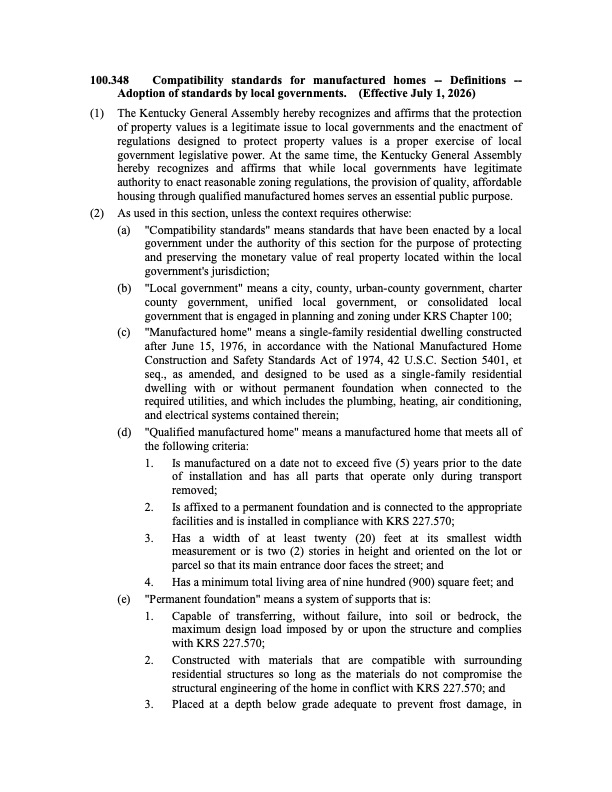
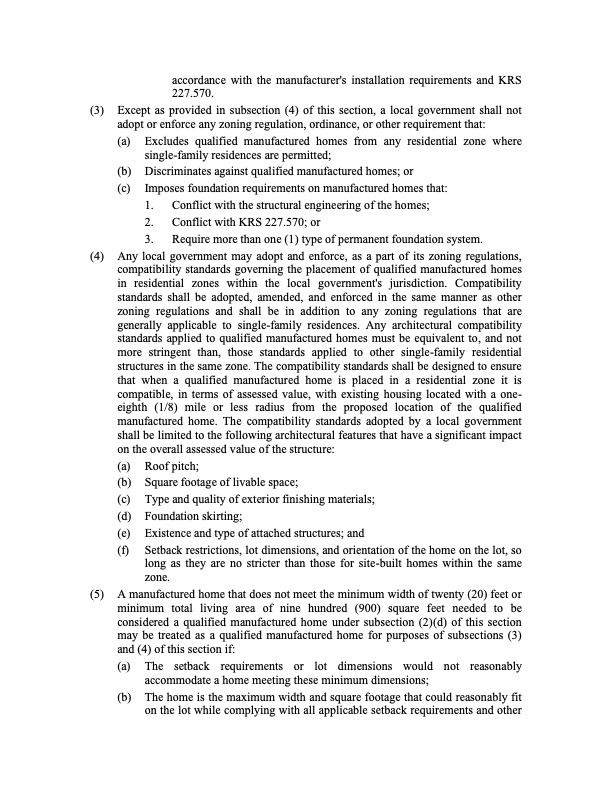
Kentucky House Bill 160/KRS 100.348
In 2025, the Kentucky General Assembly passed House Bill 160, which amended state law related to zoning and manufactured housing. The bill was signed into law on April 1, 2025 and will take effect on July 1, 2026 as KRS 100.348.
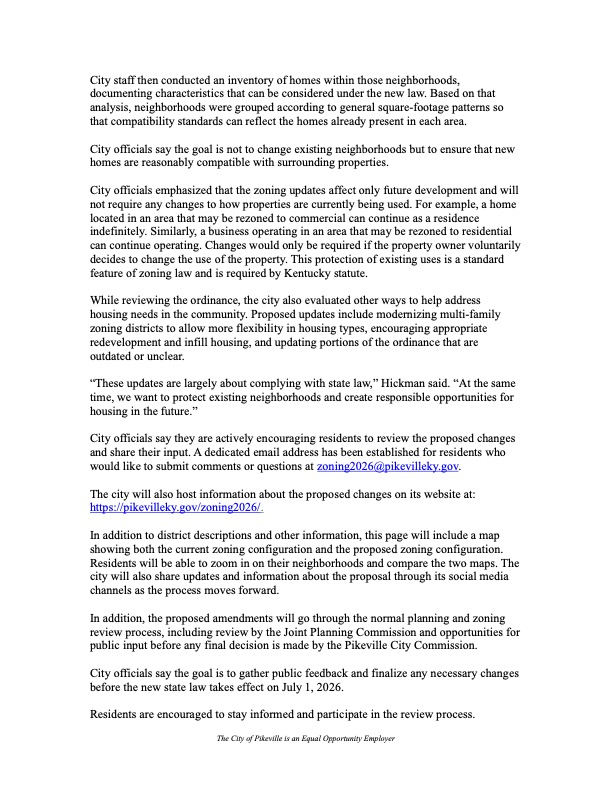
The law requires local governments to allow qualified manufactured homes in residential areas where single-family homes are permitted, provided they meet specific standards including being no older than five years old. Local governments may still adopt compatibility standards, such as square footage, roof pitch, exterior materials, and similar design standards, as long as those standards apply equally to manufactured homes and site-built homes.
The proposed zoning updates being reviewed by the City of Pikeville include changes intended to comply with this state law while protecting the character of existing neighborhoods.
Learn more about the legislation:
The city is reviewing portions of its zoning ordinance to comply with recent changes in Kentucky law, including KRS 100.348, and to update parts of the zoning framework that have become outdated over time. The review also allows the city to make improvements that support responsible housing and business development while protecting existing neighborhoods.
The proposed zoning map reorganizes some residential zoning districts to better reflect the development patterns that currently exist in Pikeville’s neighborhoods. The goal is to create zoning districts that more closely match how different parts of the city are built today. Most commercial, industrial, and institutional zoning districts remain largely unchanged.
As part of this process, the city studied 101neighborhoods and reviewed the characteristics of homes throughout the city. The proposed residential districts are intended to better reflect the size, density, and development patterns already present in those neighborhoods.
House Bill 160, passed by the Kentucky General Assembly in 2025, created KRS 100.348, which establishes new rules regarding manufactured housing and zoning.
The law requires that certain manufactured homes be allowed in areas where single-family homes are permitted, provided they meet specific standards.
Local governments are allowed to adopt compatibility standards to help ensure new homes fit reasonably with surrounding homes.
State law requires that certain manufactured homes be treated the same as site-built homes in residential districts if they meet required standards. The proposed zoning updates include compatibility standards intended to help ensure new homes fit within the character of existing neighborhoods.
Some properties may be placed in a different zoning district under the proposed map in order to better reflect existing neighborhood patterns and development characteristics. However, regardless of any change in zoning, property owners may continue to use their property as they currently are until they choose not to. Residents can review both the current and proposed zoning maps using the interactive map tool on this page.
The zoning updates will go through the normal review process, including consideration by the Joint Planning Commission and final action by the City Commission. Public meetings will be held as part of this process before any changes are adopted. The hope is to have the changes implemented before the law goes into effect on July 1, 2026.
Developing the proposed zoning updates required significant research and analysis.
City staff reviewed the new state law, studied how other communities are responding, and evaluated options for implementing the law while protecting the character of Pikeville’s neighborhoods.
As part of that process, the city conducted an inventory of more than 1,500 single-family homes to better understand the size and development patterns of neighborhoods throughout the city. This information helped guide the development of compatibility standards and proposed residential zoning districts.
Now that the initial research and analysis has been completed, the city is sharing the proposed updates and inviting public review and feedback as part of the formal planning process.
Residents are encouraged to review the materials on this page and share their thoughts.
Comments can be submitted through the contact form on this page or by emailing:
Zoning2026@pikevilleky.gov
Residents may also attend public meetings during the review process.
Additional materials, including detailed zoning descriptions and draft ordinance language, will be added to this page as the review process continues.
No. The materials on this page reflect proposed zoning updates that are still under review.
The proposal will go through the normal public review process, including discussion by the Joint Planning Commission and consideration by the City Commission before any changes are adopted.
No. State law now requires that certain manufactured homes meeting specific standards be allowed in areas where single-family homes are permitted. The proposed zoning updates include compatibility standards intended to ensure new homes fit reasonably with surrounding homes.
No. The proposed updates will go through the normal public review process, including discussion by the Joint Planning Commission and approval by the City Commission before any changes are adopted. Residents are encouraged to review the materials and provide input during this process.
No existing homes will be required to change because of these updates. The zoning changes primarily affect how future development and new construction are regulated.
Zoning regulations are one of many factors that influence property values, along with market conditions, housing demand, and neighborhood investment.
One goal of the proposed zoning updates is to ensure that new homes are reasonably compatible with existing neighborhoods, including considerations such as home size, design standards, and placement on lots. These types of standards are intended to help maintain the character of neighborhoods as the city continues to grow.
April 2025 through February 2026
City staff researched zoning options, reviewed the new state law, studied zoning approaches used by other communities, and conducted an inventory of residential neighborhoods.
March 2026
Initial public release of proposed zoning updates and launch of the Zoning2026 information webpage.
April 14, 2026
Joint Planning Commission meeting planned to include a discussion of the proposed zoning updates.
May 2026 (anticipated)
Joint Planning Commission special meeting to consider a recommendation on the proposed ordinance.
May–June 2026 (anticipated)
City Commission readings of the ordinance adopting the zoning updates.
Before July 1, 2026
Goal of completing the review process before the effective date of new state law requirements.
Regularly Scheduled Commission Meetings: March 23, April 13, April 27, May 11, May 25,
June 8, June 22.
Joint Planning Commission Meetings: Regular Scheduled April 14, Special Meeting for approval
tentatively scheduled for mid-May.
Additional materials will be added to this page as the review process continues,
including:
• Detailed descriptions of proposed zoning districts
• Compatibility standards related to housing design and placement
• Information about zoning modernization updates (such as home-based businesses,
accessory dwelling units, and digital zoning map tools)
• Draft ordinance language for the proposed zoning amendments
• Additional meeting information and presentation materials
Residents are encouraged to check this page periodically for updates as more information becomes available.

We use cookies to improve your experience on our site. By using our site, you consent to cookies.
Manage your cookie preferences below:
Essential cookies enable basic functions and are necessary for the proper function of the website.
These cookies are needed for adding comments on this website.
Statistics cookies collect information anonymously. This information helps us understand how visitors use our website.
Google Analytics is a powerful tool that tracks and analyzes website traffic for informed marketing decisions.
Service URL: policies.google.com (opens in a new window)
SourceBuster is used by WooCommerce for order attribution based on user source.
You can find more information in our Cookie Policy and Privacy Policy.